> ## Documentation Index
> Fetch the complete documentation index at: https://www.bolna.ai/docs/llms.txt
> Use this file to discover all available pages before exploring further.
# Bolna AI On-Prem guide for Enterprises
> Learn how to self-host Bolna Voice AI on your own servers using Docker or Kubernetes for secure, private, and scalable enterprise deployments.
Please reach out to us at [enterprise@bolna.ai](mailto:enterprise@bolna.ai) or schedule a call [https://www.bolna.ai/meet](https://www.bolna.ai/meet) for the Docker images and pricing info.
## 1. Introduction
### Why on-premise?
Deploying Voice AI infrastructure on your own server (on-premises or self-managed cloud infrastructure) instead of relying entirely on third-party SaaS solutions has several strategic, technical, and operational advantages, especially for companies focused on privacy, control, and performance.
### Security
With an on-premises deployment, all data remains within your corporate network, ensuring enhanced security as it is not transmitted over the Internet. This setup helps in complying with strict data privacy and protection regulations.
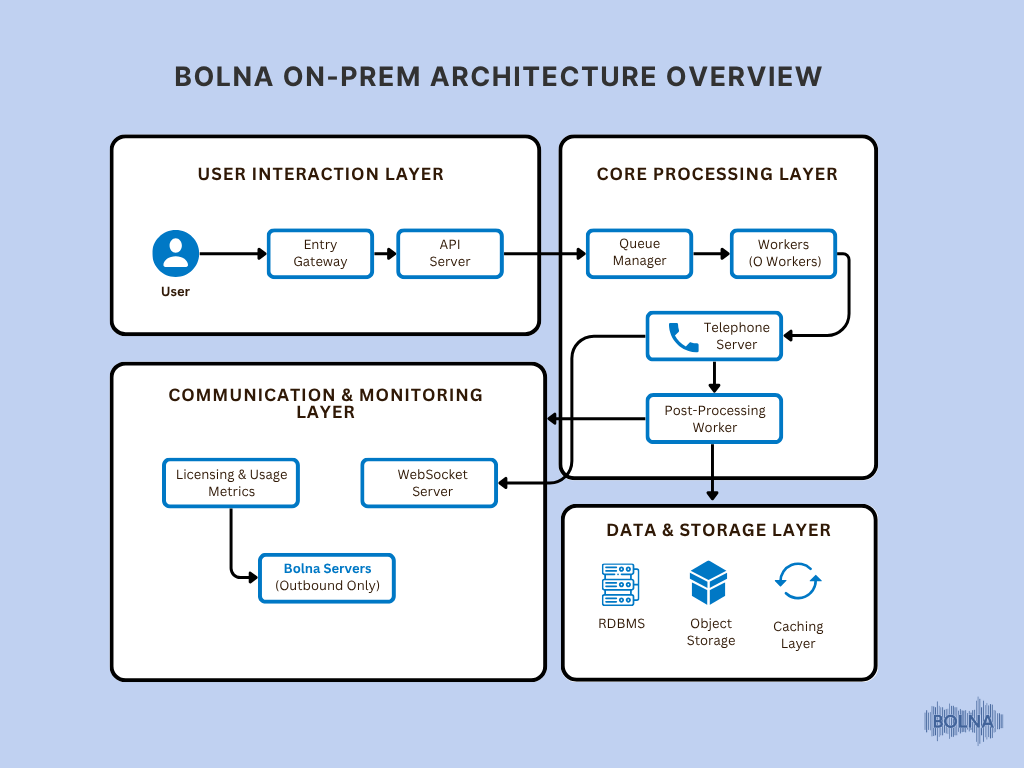
### Components
 ### Prerequisites
**Docker**: Install Docker on your system to manage the containerized application.
```bash theme={"system"}
# Add Docker's official GPG key:
sudo apt-get update
sudo apt-get install ca-certificates curl
sudo install -m 0755 -d /etc/apt/keyrings
sudo curl -fsSL https://download.docker.com/linux/ubuntu/gpg -o /etc/apt/keyrings/docker.asc
sudo chmod a+r /etc/apt/keyrings/docker.asc
# Add the repository to Apt sources:
echo \
"deb [arch=$(dpkg --print-architecture) signed-by=/etc/apt/keyrings/docker.asc] https://download.docker.com/linux/ubuntu \
$(. /etc/os-release && echo \"$VERSION_CODENAME\") stable" | \
sudo tee /etc/apt/sources.list.d/docker.list > /dev/null
sudo apt-get update
# Install the latest version of Docker
sudo apt-get install docker-ce docker-ce-cli containerd.io docker-buildx-plugin docker-compose-plugin
# Verify Docker is running
sudo docker run hello-world
# Install Docker Compose plugin
sudo apt install -y docker-compose-plugin
# Verify Docker Compose version
docker compose version
```
**Hardware Specifications**: Storage and compute requirements
* **Instance type**: c6a.xlarge
* **Object storage**: AWS S3
* **Relational Database**: PostgreSQL 16.3, RAM: 8GB+
* **Caching layer**: Redis 7.10, 4GB RAM (Instance type: cache.t4g.medium)
* **Message Queueing Channel**: RabbitMQ 13.13.7, RAM: 8GB (Instance type: mq.m5.large)
## 2. Deployment Environments
This documentation will cover specific instructions and considerations for deploying the services within an AWS environment, ensuring optimal configuration and performance.
## 3. Self-Service Licensing & Credentials
Self-hosting key can be either generated from our dashboard or contact [enterprise@bolna.ai](mailto:enterprise@bolna.ai)
## 4. Deploy All Services
### Login to Bolna's ghcr
```bash theme={"system"}
echo | docker login ghcr.io -u --password-stdin
```
### Pull images
```bash theme={"system"}
docker pull ghcr.io/bolna-ai/api_server:v1
docker pull ghcr.io/bolna-ai/ws_server:v1
docker pull ghcr.io/bolna-ai/telephone_server:v1
docker pull ghcr.io/bolna-ai/q_manager:v1
docker pull ghcr.io/bolna-ai/q_worker:v1
docker pull ghcr.io/bolna-ai/arq_worker:v1
```
### Docker Compose File:
Create a docker-compose.yml File
```bash theme={"system"}
version: '3.8'
services:
api_server:
image: ghcr.io/bolna-ai/api_server:v1
container_name: api_server
ports:
- "5001:5001"
env_file:
- .env
restart: always
telephone_server:
image: ghcr.io/bolna-ai/telephone_server:v1
container_name: telephone_server
ports:
- "8001:8001"
env_file:
- .env
restart: always
q_worker:
image: ghcr.io/bolna-ai/q_worker:v1
container_name: q_worker
ports:
- "5002:5002"
env_file:
- .env
restart: always
q_manager:
image: ghcr.io/bolna-ai/q_manager:v1
container_name: q_manager
ports:
- "5003:5003"
env_file:
- .env
restart: always
ws_server:
image: ghcr.io/bolna-ai/ws_server:v1
container_name: ws_server
ports:
- "5005:5005"
env_file:
- .env
restart: always
arq_worker:
image: ghcr.io/bolna-ai/arq_worker:v1
container_name: arq_worker
env_file:
- .env
restart: always
command: ["arq", "arq_worker.WorkerSettings"]
```
### Start docker compose:
```bash theme={"system"}
docker compose up -d
```
### Prerequisites
**Docker**: Install Docker on your system to manage the containerized application.
```bash theme={"system"}
# Add Docker's official GPG key:
sudo apt-get update
sudo apt-get install ca-certificates curl
sudo install -m 0755 -d /etc/apt/keyrings
sudo curl -fsSL https://download.docker.com/linux/ubuntu/gpg -o /etc/apt/keyrings/docker.asc
sudo chmod a+r /etc/apt/keyrings/docker.asc
# Add the repository to Apt sources:
echo \
"deb [arch=$(dpkg --print-architecture) signed-by=/etc/apt/keyrings/docker.asc] https://download.docker.com/linux/ubuntu \
$(. /etc/os-release && echo \"$VERSION_CODENAME\") stable" | \
sudo tee /etc/apt/sources.list.d/docker.list > /dev/null
sudo apt-get update
# Install the latest version of Docker
sudo apt-get install docker-ce docker-ce-cli containerd.io docker-buildx-plugin docker-compose-plugin
# Verify Docker is running
sudo docker run hello-world
# Install Docker Compose plugin
sudo apt install -y docker-compose-plugin
# Verify Docker Compose version
docker compose version
```
**Hardware Specifications**: Storage and compute requirements
* **Instance type**: c6a.xlarge
* **Object storage**: AWS S3
* **Relational Database**: PostgreSQL 16.3, RAM: 8GB+
* **Caching layer**: Redis 7.10, 4GB RAM (Instance type: cache.t4g.medium)
* **Message Queueing Channel**: RabbitMQ 13.13.7, RAM: 8GB (Instance type: mq.m5.large)
## 2. Deployment Environments
This documentation will cover specific instructions and considerations for deploying the services within an AWS environment, ensuring optimal configuration and performance.
## 3. Self-Service Licensing & Credentials
Self-hosting key can be either generated from our dashboard or contact [enterprise@bolna.ai](mailto:enterprise@bolna.ai)
## 4. Deploy All Services
### Login to Bolna's ghcr
```bash theme={"system"}
echo | docker login ghcr.io -u --password-stdin
```
### Pull images
```bash theme={"system"}
docker pull ghcr.io/bolna-ai/api_server:v1
docker pull ghcr.io/bolna-ai/ws_server:v1
docker pull ghcr.io/bolna-ai/telephone_server:v1
docker pull ghcr.io/bolna-ai/q_manager:v1
docker pull ghcr.io/bolna-ai/q_worker:v1
docker pull ghcr.io/bolna-ai/arq_worker:v1
```
### Docker Compose File:
Create a docker-compose.yml File
```bash theme={"system"}
version: '3.8'
services:
api_server:
image: ghcr.io/bolna-ai/api_server:v1
container_name: api_server
ports:
- "5001:5001"
env_file:
- .env
restart: always
telephone_server:
image: ghcr.io/bolna-ai/telephone_server:v1
container_name: telephone_server
ports:
- "8001:8001"
env_file:
- .env
restart: always
q_worker:
image: ghcr.io/bolna-ai/q_worker:v1
container_name: q_worker
ports:
- "5002:5002"
env_file:
- .env
restart: always
q_manager:
image: ghcr.io/bolna-ai/q_manager:v1
container_name: q_manager
ports:
- "5003:5003"
env_file:
- .env
restart: always
ws_server:
image: ghcr.io/bolna-ai/ws_server:v1
container_name: ws_server
ports:
- "5005:5005"
env_file:
- .env
restart: always
arq_worker:
image: ghcr.io/bolna-ai/arq_worker:v1
container_name: arq_worker
env_file:
- .env
restart: always
command: ["arq", "arq_worker.WorkerSettings"]
```
### Start docker compose:
```bash theme={"system"}
docker compose up -d
```